
Weeks can turn into months faster than you’d think. You both know something has shifted. Neither of you has said it out loud yet. Every night follows the same pattern: phones out, lights off, goodnight. And the longer it goes on, the more impossible it feels to change.
If this sounds familiar, you’re not in a broken relationship. You’re in a very common one. A dry spell doesn’t mean love has faded. It usually means life got heavy and intimacy quietly slipped down the priority list. The real problem isn’t the gap. It’s the way the gap slowly starts to feel permanent. This article gives you a clear, step-by-step way to close it.
Why Dry Spells Happen
Life has a way of crowding out intimacy without you even noticing. A new baby arrives, and you’re both running on empty. Work pressure builds. Someone gets sick or deals with grief. Medication changes affect how you feel. These are normal human experiences, not signs that something is fundamentally wrong.
The real issue shows up when neither of you knows how to restart. Once intimacy stops, picking it back up starts to feel like a much bigger deal than it actually is. The longer the gap sits, the heavier it gets. That’s why waiting rarely helps.
Why It Feels So Awkward to Restart
The awkwardness usually comes from overthinking. You start asking yourself whether your partner is still interested, whether a move will land badly, or whether enough time has passed that things just feel strange now. On top of that, both of you might be waiting for the other person to go first. So you end up in a quiet standoff, both wanting the same thing, neither willing to risk it.
Here’s the thing, though: the fact that you feel nervous about reconnecting is actually a good sign. It means the relationship matters to you. That discomfort isn’t a warning to back off. It’s just a sign you care. And it won’t last once you move through it.
The Mental Shift That Makes This Easier
Before anything else, try shifting how you’re thinking about this. Stop waiting for the perfect moment, because it probably won’t show up on its own. There will always be something going on; for some reason, the timing feels slightly off. Waiting for ideal conditions is really just waiting forever.
It also helps to remember that your partner is almost certainly feeling the same way you are. They’re likely just as uncomfortable, just as unsure, and just as reluctant to go first. You’re on the same team here, not on opposite sides. So the goal isn’t to perform or impress. It’s just to invite connection. That’s a much lighter thing to carry.
Step 1: Have the Conversation First
The most important first move is also the simplest one: say something. Bringing it up out loud removes the guessing and turns it into something you’re working on together.
You don’t need a script. Something honest and low-key works perfectly well. Try: “I miss being close to you. Can we talk about it?” Or: “I know it’s been a while. I’d like us to reconnect, but I’m not sure where to start.” Keep the focus on what you want, which is connection, rather than what’s been missing.
When your partner responds, pay attention. Are they relieved you brought it up? Is there a reason for the distance, like stress or a health issue, that you weren’t aware of? If there’s unresolved tension between you, it’s worth working through that before expecting physical closeness to feel easy again.
 Step 2: Rebuild Physical Comfort Before Anything Else
 Step 2: Rebuild Physical Comfort Before Anything Else
Don’t rush straight to sex. Your bodies need time to feel comfortable together again first. Start with non-sexual physical affection: longer hugs, holding hands while watching TV, sitting close on the sofa instead of at opposite ends. Small touches in passing, like a hand on the shoulder in the kitchen, count too.
Give this a few days to a week. The goal is to make touch feel normal and low-stakes again, so that physical closeness no longer feels like something that has to lead somewhere.
Step 3: Create Low-Pressure Time Together
Once daily touch starts to feel natural again, create space for intimacy without making it the stated goal. A quiet evening in, staying up together after the kids are asleep, or a slow morning coffee in bed all work well. The point isn’t to engineer a moment. It’s to spend time together without distractions, where something can happen naturally if you’re both feeling it.
Emotional closeness matters here, too. Talking about something real, sharing appreciation, asking what’s been on your partner’s mind, all of this makes physical closeness feel safer. When you feel genuinely connected through conversation, your body tends to follow.
Step 4: Make the First Move, Gently and Clearly
At some point, someone has to go first. Start small and be direct. You don’t need to go from nothing to everything in one night. A clear, gentle invitation is enough. Try: “I’d really like to be close to you tonight. Would you like that too?” You can also use physical cues, like a kiss that lasts a little longer or a touch that makes your interest clear.
The first time might feel slightly out of practice, and that’s completely fine. You’re breaking a pattern that has been in place for a while. What matters is that you’re reconnecting, not that everything feels perfect straight away.
If your partner says not tonight, don’t read too much into it. Ask if another night this week would work better, and try again in a day or two. One “not tonight” isn’t a rejection. It’s just a timing issue.
Step 5: Build Momentum and Don’t Let Another Gap Grow
Now comes the part most people overlook. Once you’ve reconnected, keep the momentum going. For most couples in long-term relationships, desire tends to follow connection rather than lead it. You often don’t feel like it until you start.
Pay attention to what feels right for you as a couple. Some people find that once a week works well. Others prefer more or less. There’s no correct answer here. What matters is that you keep up daily physical affection and stay alert to signs you’re drifting again. If you notice the gap starting to widen, bring it up sooner rather than later. The earlier you catch it, the easier it is to fix.

When to Get Outside Help
Sometimes what looks like a dry spell is actually something deeper. If there’s built-up resentment between you, a couples therapist can help you work through that before physical closeness feels safe. If one partner genuinely doesn’t want to reconnect, that’s a conversation worth having with professional support. If medical factors are involved, like hormonal changes or medication side effects, a doctor is the right first call.
Asking for help isn’t a sign your relationship is failing. It’s a sign you’re taking it seriously.
Moving Forward
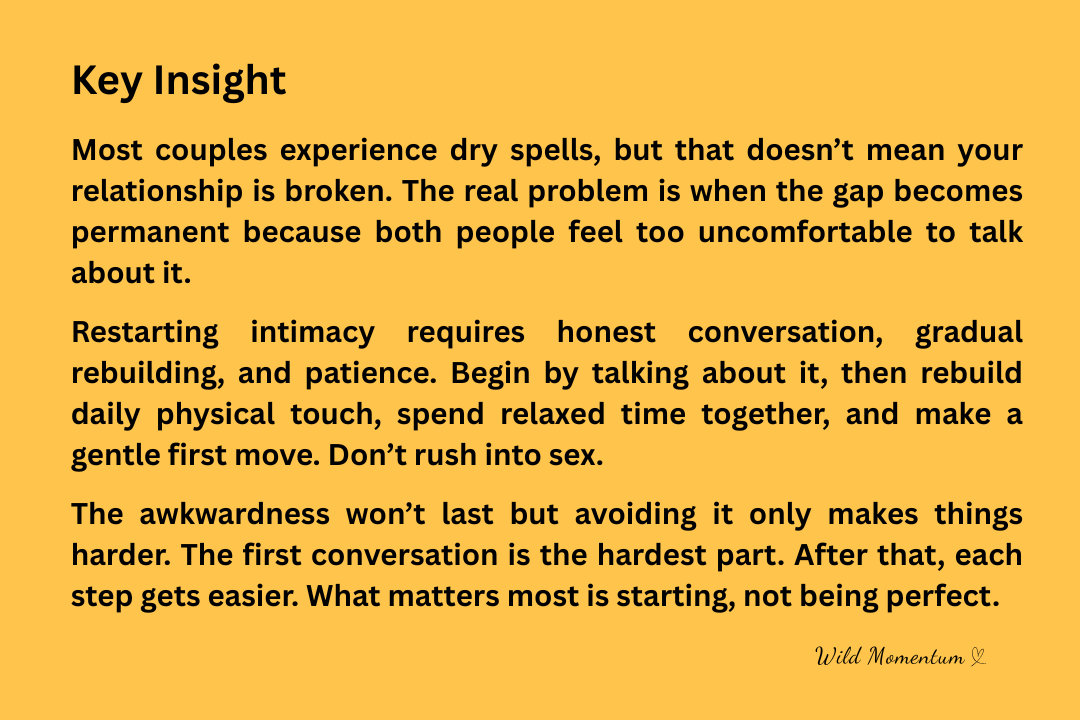
The awkwardness you’re feeling right now is temporary. It doesn’t say anything permanent about your relationship. Every couple goes through periods of distance. The ones who stay connected are the ones who notice the drift and decide to do something about it, even when it feels uncomfortable.
You don’t have to fix everything at once. Start with one conversation. Rebuild touch slowly. Create time together. Then make the first move, gently. The gap doesn’t define where you are. What you do next does.