
We were all handed the same script growing up: study hard, get a degree, land a stable job—and the money part? It’ll sort itself out.
But that script? It’s starting to feel ancient. As AI and automation gain momentum, jobs that seemed secure five years ago are being replaced—or completely reshaped—by algorithms.
Here’s what I’ve realised: if you want absolute financial stability in this new world, you need income streams that don’t rely on trading your time for money. The first time I earned money from a blog post—while AI helped me optimise the SEO—I felt something shift. This wasn’t just about earning while I slept. It was about building a future that didn’t depend on me always being “on.”
Let me show you what worked for me—and what might work for you, too.
1. AI-Smart Investing: Let the Algorithms Do the Heavy Lifting
The stock market used to feel like another language. I’d open trading apps, stare at the charts, and quietly panic.
That changed when I started using an AI-driven investment platform. Suddenly, I wasn’t guessing anymore. The app adjusted my portfolio automatically based on market trends—no more doomscrolling and rash decisions.
If you’re new to investing, this can be a surprisingly gentle way in. You’re still in the driver’s seat, but the car has smart brakes and GPS.
Start by downloading an AI-backed investment app. Let it steer while you learn the rules of the road.
2. Affiliate Marketing That Doesn’t Feel Gross
When I first heard about affiliate marketing, I pictured pop-up ads and salesy nonsense. But it doesn’t have to be that way.
I started with a tiny WordPress blog, writing about tools I genuinely used. I added links and forgot about them. A month later, I saw my first commission. It was less than a coffee, but I remember grinning like I’d won the lottery.
Now, AI helps me track what my readers care about, test headlines, and time posts just right. But the trust? That still comes from being real.
Pro Tip: When blogging and opt to affiliate marketing, utilise AI for data analysis. Use your voice for everything else. People can tell when you mean it.
3. Short-Term Rentals, Long-Term Sanity
When I managed a rental property manually, I’d often receive calls about leaky taps at 10 pm. It was chaos.
Then I discovered smart locks, automated messaging systems, and pricing tools. Game-changer. Now my rental basically runs itself, and I haven’t had a midnight maintenance call in over a year.
In a world where remote work and travel are blending, this space is only growing. You don’t need five properties. Just one—and the right tech stack.
How AI can adds on: Use innovative tools for guest communications and pricing. You manage the vision. Let tech handle the rest.
4. Create Content with Soul (and Speed)
Here’s the thing: AI can write a decent article. But it can’t tell your story.
I use AI to brainstorm and repurpose old content, but when it comes to tone, emotion, and little quirks, I step in. That’s the stuff people connect with.
One of my blog posts only took off after I rewrote it with a personal story at the top. Before that? Crickets.
Let AI help with the bones. But bring the heartbeat yourself. That’s what people come back for.
5. Protecting Creative Work in a Copy-Paste World
I remember the first time I saw an AI tool mimic someone’s art style. It was impressive—and slightly terrifying.
If you create things, you need to think about how to make them yours in ways a bot can’t copy. For me, that meant leaning into work that was raw, weird, or personal. It also meant watermarking and uploading to platforms that actually protect creators.
Start small. Add metadata. Choose platforms that respect your ownership. Think of it as futureproofing your originality.
6. Freelancing with a Machine Sidekick
Freelancing used to mean doing everything myself—from wireframes to delivery decks. Burnout wasn’t a risk; it was a guarantee.
Then I started using AI tools to build tedious tasks more efficiently. I could focus on the actual creative thinking—the part for which clients really wanted me.
One client told me, “I don’t care how you got there. I love your brain.” That’s when it clicked. AI can help. But I still bring the magic.
Offer what AI can’t—taste, intuition, emotional context. Package that with innovative tools and you’re golden.
7. Teaching Skills People Actually Need Now
The first course I launched was about productivity. It did okay.
Then I added a bonus module on “How to Use AI to Get More Done.” That one lesson became the most-watched part of the whole thing. Why? Because people aren’t just looking for information anymore—they want guidance they can actually apply.
We’re all trying to keep up. If you’ve figured something out, there’s probably someone out there who’ll pay to learn from you.
Take what you know. Add an AI angle. Make it practical and address real-life challenges.
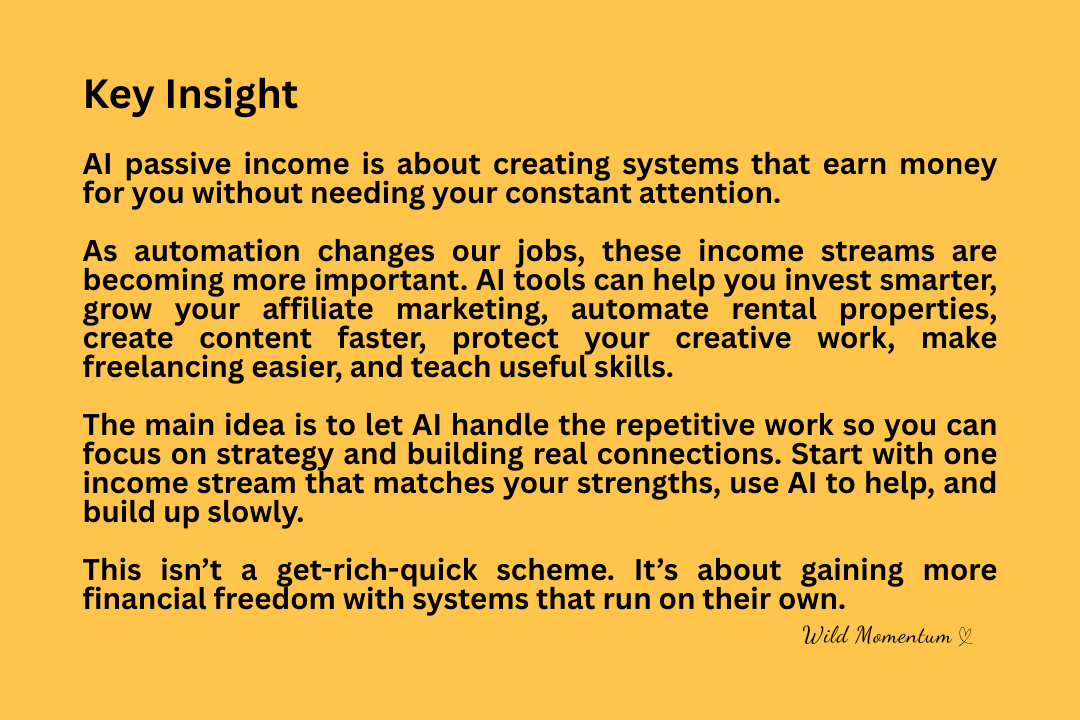
Final Thoughts: Build Something That Works Without You
Passive income isn’t about sipping cocktails while the world burns. It’s about creating breathing room—financial, emotional, mental.
AI can be overwhelming, yes. However, it can also be a powerful ally if you let it support the systems that generate your income. The key? Stay human. Use your story, your perspective, your weirdness. That’s the stuff that never goes out of style.
Pick one income stream that speaks to your strengths. Start messy. Test. Adjust. Grow. Let it evolve alongside you.
Because the future isn’t waiting, but you don’t have to chase it blindly.
You’ve got tools. You’ve got insight. And now, you’ve got options.