
Many couples quietly believe that real desire should feel spontaneous. It might be a glance across the room, a sudden spark, or a strong pull toward your partner. When desire happens this way, it feels easy and natural.
But when desire doesn’t happen on its own, and you have to think about it or plan for it, it can feel like something is wrong. So couples wait, and weeks can turn into months. This waiting brings its own problems. Pressure and anxiety build, and you might start to worry that the passion is gone for good.
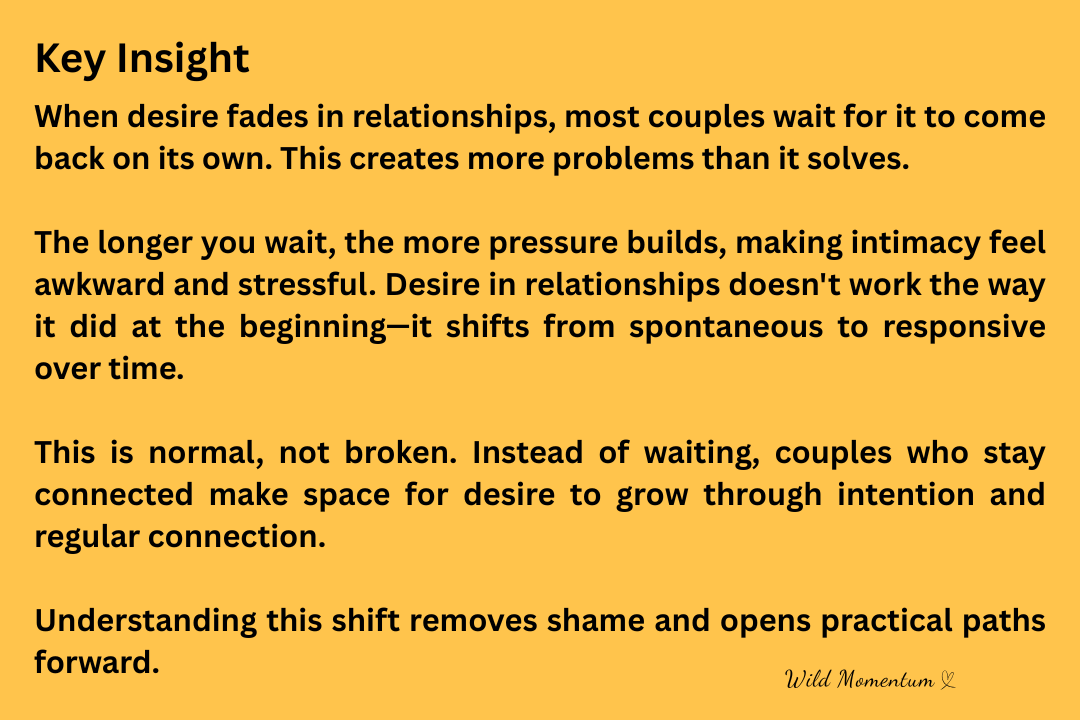
What often goes unsaid is that waiting for spontaneous desire in a long-term relationship usually makes things worse, not better. Learning why this happens can be a relief.
 Why Most Couples Wait (And Why It Backfires)
 Why Most Couples Wait (And Why It Backfires)
From an early age, we learn that real desire should be spontaneous. Movies, books, and songs show it as something that just happens, sparked by a look or a moment, sweeping you both up. It feels urgent, overwhelming, and out of your control.
At the start of a relationship, desire often works this way. Everything feels new. Your brain releases dopamine every time you see your partner. You notice all the little things about them—their laugh, how they move, and the small details that are exciting because you’re still getting to know them.
But this level of intensity isn’t meant to last forever. Your brain can’t keep up that much dopamine for long. As you become more familiar with each other, the urgent excitement naturally fades.
This is where couples often start to worry. If you think spontaneous desire is the norm, its absence can feel like something important has changed. You might wonder if the attraction has faded or if you’re no longer compatible.
Rely on talking about how attraction changes over time, so when it does, people feel alone. The question becomes: has everyone else kept the passion alive, or is planning for intimacy actually normal?
What Actually Happens When You Wait for the Mood to Strike
If you think desire should always feel spontaneous, you’ll end up waiting for the mood to strike. In a long-term relationship, where responsive desire is common, this could mean waiting a long time.
The gap between intimate moments grows. Two weeks become three weeks becomes longer. That awareness creates anxiety, and anxiety is one of the most effective desire-killers there is.
The more you worry about not being intimate, the harder it is to feel open to it. You might keep track of how long it’s been, wonder if your partner has noticed, or try to guess if tonight will be the night.
All of this adds pressure, and pressure makes it even harder to feel desire.
The Cycle That Keeps Desire Stuck
One or both partners feel the pressure but aren’t sure how to talk about it. Bringing it up can feel awkward, but staying silent only increases the distance between you.
Sex becomes a source of tension instead of connecting. Sex can start to feel tense instead of connecting. The longer you avoid talking about it, the harder it is to bring it up. You might not want your partner to feel pressured, and your partner might not want to seem uninterested.
So both of you stay quiet, hoping the other will take the first step. A lack of desire makes you wait longer. The cycle repeats, and intimacy becomes something you’re avoiding instead of enjoying.
Distance can start to feel normal. You might begin to think this is just how things are now, or worry that the spark is gone for good.
Why Spontaneous Desire Isn’t Coming Back
Here’s the shift that changes everything: desire in relationships works differently after the early stage. The change from spontaneous to responsive desire isn’t a sign of failure. It’s how attraction naturally evolves when you build a life with someone.
In new relationships, your brain sees your partner as a source of excitement and reward. Novelty is a big factor. You don’t know how they’ll react, what they’re thinking, or how things will turn out. This uncertainty keeps your attention focused and your desire strong.
But novelty can’t last. Over time, your brain adjusts. Familiarity replaces uncertainty. You know your partner deeply now. This is beautiful, and it’s the foundation of intimacy, trust, and partnership. But it doesn’t produce the same kind of spontaneous, urgent desire that novelty once did.
This is when responsive desire comes in. Unlike spontaneous desire, which just appears, responsive desire develops after you start being intimate. Arousal and interest grow in response to touch, emotional connection, or time spent close.
It’s not a lesser kind of desire. It’s just different. It’s like appetite. Sometimes you don’t feel hungry until you start eating, but once you do, you enjoy the meal. Responsive desire works the same way. You might not feel a strong urge before intimacy, but once you’re present and connected, desire appears.
What Works Instead of Waiting
Switching from waiting to being intentional can feel uncomfortable for many people. It might seem mechanical, as if intimacy is just another task. But being intentional doesn’t have to feel like that.
You make time for things you value. Dinner with friends, exercise, hobbies, and meaningful conversations. Making intimacy a priority isn’t unromantic. It shows that your relationship matters and you’re not leaving it up to chance.
Being intentional means setting up the right conditions for desire to grow. You make time to connect and show up with openness, even if you don’t feel a strong urge at first. You trust that the connection will help desire develop.
You may need to change how you think about desire. Instead of believing, “I need to feel desire before I can be intimate,” try thinking, “I’m open to desire growing as we connect.”
What matters most is being truly willing, not just doing it out of obligation.
Responsive desire still brings real pleasure and longing; it just begins in a different way. You’re not faking it—you’re making room for intimacy, and most of the time, once you’re present and engaged, desire follows.
What Makes Desire Easier in Relationships
Before worrying about technique or novelty, look at the basics. Desire in relationships needs a foundation.
Getting enough sleep matters more than you’d think. An extra hour of sleep each night can boost libido by about 14%. Being tired doesn’t just make you too exhausted for intimacy. It also affects your ability to feel open, enjoy pleasure, and connect.
Daily affection outside the bedroom creates the emotional conditions that support sexual connection. This means touching your partner without it being a signal that you want sex. Showing genuine interest in their day. Give them your full attention when you’re together.
These small moments help you feel close and in tune with each other, making intimacy feel natural instead of awkward.
Relationship tensions also play a role. If there’s resentment about chores, feeling unseen, or ongoing arguments, those issues don’t just go away when you try to be intimate. Desire grows when both people feel respected, valued, and cared for in the whole relationship, not just in bed.
How to Stop Waiting and Start Connecting
Begin by understanding that desire works differently now. Not having spontaneous desire doesn’t mean something is wrong—it’s normal in long-term relationships.
Have an honest talk with your partner. Discuss how desire works for each of you, what helps you feel open to intimacy, and how you both want to make connection a priority. Even this clarity can help you feel closer.
Make space for intimacy without putting pressure on it. This could be as simple as agreeing that Saturday mornings are your time together, or choosing to connect on evenings when you’re both home. The goal isn’t to schedule sex strictly, but to create the right conditions for desire to grow.
Build daily connection by touching each other outside of sex. Huga little longer, hold hands, or sit close on the couch. These small acts of affection help keep intimacy feeling normal and safe.
Take care of the basics. Get more sleep when you can, reduce stress where possible, and work through relationship tensions rather than letting them build up. These foundations make it easier to feel desire.
Be patient with yourself and your partner. Changing how you approach intimacy takes time. What matters most is being consistent, not perfect.
Moving Forward
Desire in relationships changes over time, and that’s okay. Waiting for the spontaneous desire to return won’t help. What works is understanding how desire really functions in long-term relationships and creating the right conditions for it to grow.
You’re not settling. You’re being realistic about how intimacy works as you build a life together. You’re choosing intention over hope, connection over waiting, and sustainability over magic that might never arrive.
You don’t need perfect passion to keep desire alive. You need consistency, honest communication, and a willingness to show up. Start where you are. Make space for connection. Trust that desire will follow when you create the right conditions.
This kind of connection is no less meaningful than early passion. In fact, it’s often deeper because it’s built on truly knowing your partner and choosing each other every day.